March 24, 2014
 There are certain things, which a forex trader should know. Before you start to trade, you must pay heed to certain tips. You must be in search of high returns at low risks in currency trading. A managed forex account is the answer to your situation. A money manager manages the forex account in your behalf. It is similar to hiring an advisor who can handle your accounts. You must do your homework well in advance before you opt for a managed forex account. Traders use managed forex accounts these days as they are low on risk. If you do not have enough time to spend on forex, you can opt for a managed forex account.
Open a forex managed account
There are several benefits of opting for managed forex account. The daily turnover of the forex market is $4 trillion. Due to the profit making opportunities which it offers it attracts a large section of traders across the world. By opting for managed forex accounts, you can reduce the time and effort which is invested in forex. If you have enough capital in hand, and wish to earn profits through forex trade, you can opt for forex managed accounts. With this type of account, you will be able to avail the services of a professional who will manage your account and cash.
Advantages of managed forex account
As an expert handles your cash and account, you will have high chances of maximising your profits. You can enjoy high leverage when you trade forex. You can have a tailor-made technical analysis report which can prove as an important tool in forex trade. Although the managed forex accounts involve some risks, the returns are very high. You can diversify your capital easily such that chances of a single risk are reduced. You can benefit from the daily market reports and trading reports which you receive.
Trade successfully
On a managed forex account, you can enjoy high levels of liquidity. You will be able to liquidate your assets easily and withdraw the amount whenever you choose to. You can trade in both rising and falling markets. You can make use of both major and minor currencies in forex trade. The initial amount for a forex managed account is very low. You can depend on reliable fund managers who can manage your cash and your account effectively. You can keep full control when you invest in a managed forex account.
Accounts work to your advantage
Investing in a forex managed account can work to your advantage. A well run account can help you earn a large amount of profit in a short span of time. The returns, which you achieve, may outperform the profits which you make in case of traditional investments. Profits can be made in the direction of the market. You can easily add and withdraw cash from your account. An account, which is run well, will have very low risks. You can opt for USA binary options brokers who can help you to realize risk-adjusted high returns.
An innovative approach
You can withdraw money without penalties and withdrawal fees. You should ensure that risk in case of a managed account is low. If exposure to unpredictable market situations is reduced, you can lower the risks which your cash and account faces. If you are a savvy trader, you must understand the benefits of a managed account. You must select a company which has large experience in forex trading so that it can handle your account efficiently. Investing in a managed forex account can be an innovative and a good alternative to traditional investment strategies.
Stacey R Morris opted for forex USA binary options brokers when she wanted to trade in forex binary trade. The brokers were flexible and helped her to trade variations. She learnt that she could use a news situation to her benefits and earn profits on the trade.
Tags:
Business,
Currency,
economy,
Foreign Exchange,
Forex,
investments,
money,
Trade
February 26, 2014
 Effective marketing is vital to improving your brand image and generating business, but it’s also important that this is done efficiently. Marketing should balance cost with efficacy in a way that most benefits your business and is most relevant to your market. Here are a few basic elements that will help ensure your business is being marketed efficiently and keeping wasted money to a minimum.
Do Your Market Research
Conducting thorough market research is vital to a successful and efficient marketing strategy. You must determine your target market and assess their wants and needs in a way that will help you appeal to them directly. Your market research will also allow you to determine the best platforms on which to deliver your content, and ascertain the “when and where” that will give you the best bang for your marketing buck.
Target Effectively
Once you have pin-pointed your target market you can build your marketing strategy around them. You need to market directly to your target demographic based on how best to reach them and what appeals to them most. If you can tailor your strategy around this target market you’ll be marketing more efficiently.
Avoid Wasted Reach
By keeping your sights on your target market you’ll be helping to avoid wasted reach as well. With thorough market research you’ll be able to avoid putting money into any advertising that will reach people outside of your target market – wasted reach equates directly to wasted money and inefficient marketing.
Deliver a Compelling Message
In order to appeal to your target market, you must catch their attention and leave an impression with a compelling message that’s relevant to them and their needs/desires. This message should be memorable and simple, and contribute positively to your brand image. A truly compelling message should be able to influence audience behaviour and build customer relationships with the brand.
Build Customer Relationships
Use your marketing to promote interaction between the brand and your customers in a way that will build lasting brand relationships and promote trust. Market yourself in a way that creates a positive brand image for the customer to relate with or desire. Deliver meaningful content and make yourself memorable. Social media marketing and content marketing are at the forefront of this customer relationship-based approach.
Track Your Goals and Measure Effectiveness
Your marketing strategy should include goals and milestones to be reached in order to track the effectiveness and efficiency of your approach. Track your progress toward these goals and constantly monitor the market to gauge the effectiveness of your marketing. If you’re not reaching these goals, it’s vital to re-asses your approach and modify if to get back on track. The failure to reach goals means your approach may be wasting money and this could even harm your brand.
The best way to value for your marketing dollars is to enlist the help of a marketing professional who will stay on top of market trends and advertising approaches in a way that’s relevant to the ever-changing marketing environment. Market Smartly, for example, can help with anything from planning to execution to training to support. Having professionals behind you will help keep your strategy efficient and on track to its goals.
With the right planning and attentive execution, you can turn marketing dollars into solid profits.
Tags:
Business,
Business Trends,
Cash Flow,
Currency,
economy,
Marketing Ideas,
money
February 7, 2014
Hands up if you’ve got your tax act together! What? No hands up? Well then, grab a seat and listen up!
The State and Federal governments have set up certain due dates for filing or e-filing your taxes. To some, understanding taxes and meeting tax deadlines is the first among many horrifying aspects of filing tax returns. But once you understand when and what needs to be filed, it will be the first big step you’ve taken towards de-horrifying the process of tax filing and returns.
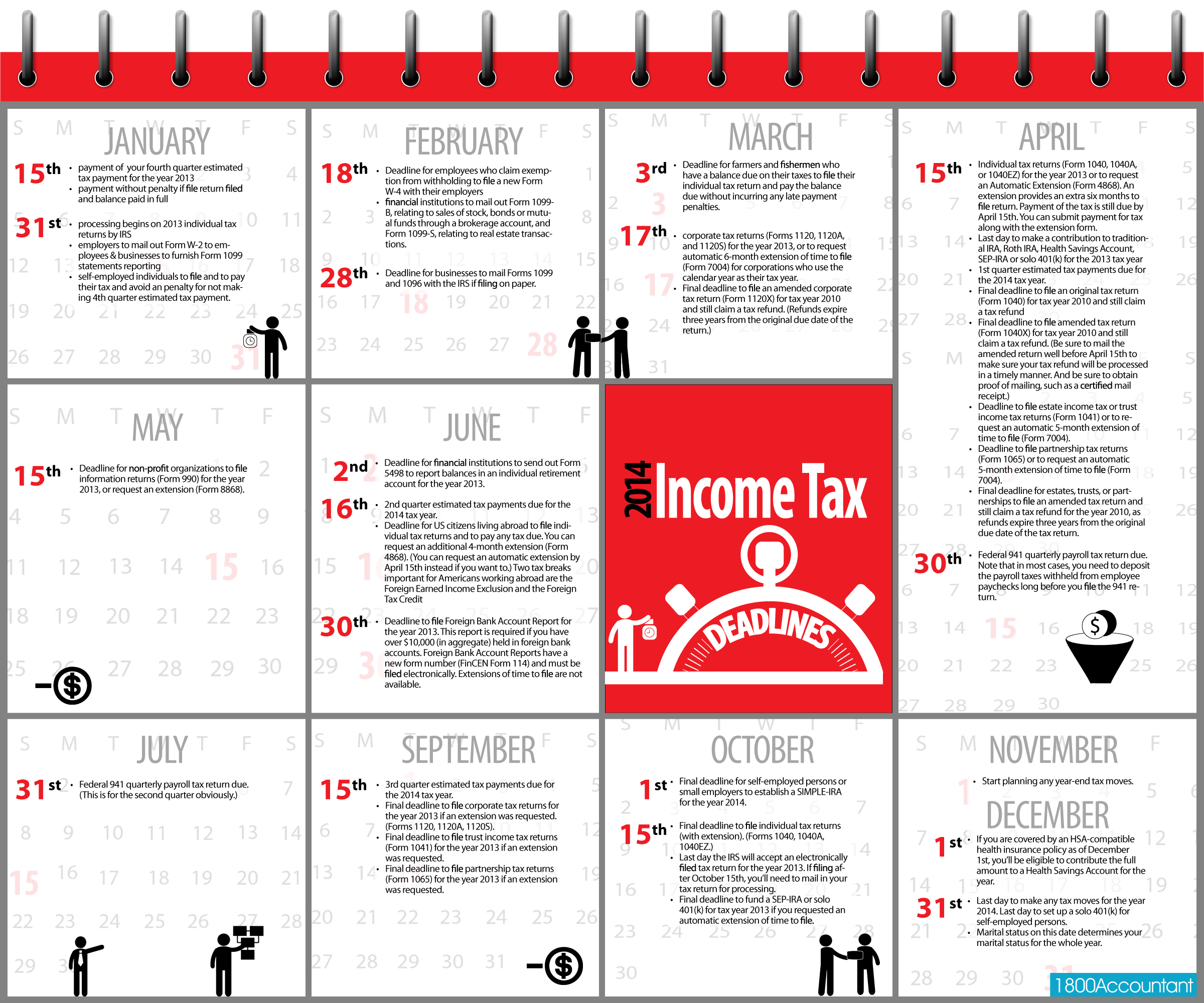
April 15th is a big date to remember. Not only must you file your taxes by this day but you also need to pay an estimate of any taxes due. 11.59 pm on that day is the deadline. Miss that and you’ll need to request an extension from the IRS. And even if you do request an extension, remember you still need to pay the taxes you owe.
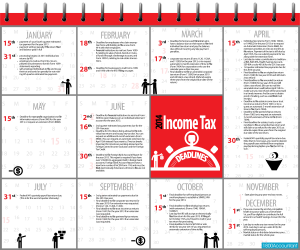
In addition to that big date, there are several due dates to keep in mind depending on your status – whether you’re individual tax payer, a business (S corporation, C Corporation or LLC) or a charity. The infographic below will help you keep a track of those dates. Remember, if a filing date falls on a weekend or a national holiday, the date will be moved forward to the next working day. It’s important not to miss these dates because if there’s one thing you don’t want, is the IRS on your back, right?
What happens if you don’t meet the deadline?
Brace yourself! This is the next horrifying part of filing taxes. A lot. A lot of bad things can happen if you don’t meet that deadline. For one thing, the fee for not filing is a lot harsher than it is for late filing. In addition, there are penalties which you can check out on the IRS website.
What Not to Forget
You’d be surprised at the common mistakes people make when filing their taxes. Before you send those papers to the IRS double check whether you’ve:
• Put a stamp on the envelope
• Signed the documents (Don’t laugh. It happens more often than you’d think)
• Included the social security numbers of their children and adult dependents
• Annual limits and tax tables can change from year to year. Make sure you’re using the right.
If you run a small business, there’s a never-ending string of dates that you have to keep in mind. Make entries in your PDAs, your laptop and any other devices you use to keep your appointments to help you stay on top of things.
What to Remember
Remember to take advantage of tax deductions. These may change from year to year as well and I sometimes suspect it is in the IRS’s best interests to confuse us folks! It may help to hire professional accounting firms whose job it is to prepare and file your returns while maximizing your earnings. Firms, like 1800accountant, designate a personal accountant to your case and offer 24/7 access the whole year round. It’s worth looking into such services and enjoy the peace of mind that comes from knowing you’ve got your taxes taken care of and managed to make some tax savings. Now that’s what I’m talking about. 🙂
Tags:
budgeting,
economy,
Income Tax,
money,
tax
January 9, 2014
 A sustained bull market has equity investors anticipating a lucrative 2014. A weak dollar and low interest rates are among several factors that bode well for corporate profits in the New Year.
With a low dollar, export driven companies can expand into overseas markets by competitively pricing their products. To raise money, companies can issue low coupon bonds that easily exceed the yields of low risk treasuries. Robust venture capital has non-traditional borrowers turning to Elliott Broidy and other financiers for needed capital.
The past several years have seen many investors chase returns and buy securities with the strongest short term performance. As a result, many investor portfolios have grown to reflect the broader market.
Fortunately, there are convenient ways to reduce the risk of a portfolio that moves in lockstep with equity markets. Beyond hedging, these investments may be suitable as mainstays in your portfolio.
Below are some strategies to consider:
Intermediate Bonds:
Low yields are posing challenges for income investors. Risk free treasuries offer safety but little income. The rock bottom treasury yields make it affordable for non-government bonds to compensate investors for added risk. Investors should also have perspective on the impact of interest rates rising in the future.
Bond maturities of 3 to 10 years offer an attractive hedge for several reasons. These bonds add negative correlation by mostly moving in different directions from the broader market. Intermediate maturities are also attractive when there is uncertainty about interest rates.
It is unlikely that short term rates determined by the Federal Reserve will head any lower. Similarly, when and if rates will rise is also uncertain. Intermediate bonds allow you to earn yield above that of shorter maturities, without the interest rate risk of long term debt, which would be battered by rate hikes.
For most investors, mutual funds are a convenient way to buy intermediate bonds. You should review the credit quality and interest rate sensitivity of bond mutual funds through Morningstar or Bloomberg.
Depending on your risk tolerance and income needs, international bond funds may also be an option. If you plan to draw income, interest payments from stronger currencies will be increased when converting into dollars.
Real Estate Investment Trusts (REITs):
Do you want real estate exposure without the hassles and expense of owning investment property? You should consider exchange traded REITs as an affordable and liquid alternative.
These publicly traded securities are required by the IRS to pay out 90% of taxable income to shareholders. Income starved investors appreciate that many REITs currently feature yields over 6%, with some international options paying double digit yields.
Real estate is a volatile asset class that often moves separately from equity markets. However, the cash, financing and time needed is beyond smaller investors. Unlike owning real estate, REIT shares can be easily bought and sold. You can quickly take and unwind positions as investment goals or real estate markets change.
REITs also allow you to capitalize on demographic trends such as an aging population or healthcare laws. Investing in REITs that specialize in elderly care facilities or geographic regions with thriving real estate markets are examples of this.
To soften volatility, you may choose hybrid REITs that collect rent payments and also earn mortgage interest. With lending and rental revenue, a hybrid REIT is more poised to benefit from different real estate trends.
Low cost and the ability to diversify make ETFs or mutual funds suitable for most REIT investors. International REITs give you access to overseas property markets. Similar to overseas fixed income, dividend payments from foreign REITs may be increased in dollar terms. Your currency adjusted returns could also be higher during times of dollar weakness.
Summary:
Portfolio rebalancing can include adding small doses of volatility to reduce the overall risk in your portfolio.
By considering the impact of a bull market on sector weights, market cap and asset exposure; you gain better perspective for changing conditions.
Tags:
Business,
economy,
Foreign Exchange,
Forex,
investment
November 26, 2013
 There are many reasons why it can sometimes be a good idea to borrow money. It can make it possible to invest in assets in a way that makes financial sense – for instance, taking advantage of a discount on a new sofa that’s really needed, where the saving amounts to more than the interest on the loan. It can be about consolidating debt, using one big loan to pay off several smaller ones, which often results in lower overall interest payments and better terms and conditions. In some situations, it can be necessary to meet ordinary household expenses whilst waiting for a salary payment, especially if one has a variable income or creditors that are slow to pay. Getting a loan to pay for transport costs can also make sense by making it possible to stay in work and thereby keep bringing some money in. Whatever the reason, it’s something that should be approached with caution – and with a clear plan for paying the money back firmly in place.
Borrowing options
The simplest way for most people to borrow money is by getting a loan from the bank, but rates can vary a lot and people with poor credit records may struggle to do this at all. Social fund and credit union loans can be a good bet but what’s available can vary by location. The Citizens’ Advice Bureau can provide guidance on this. Credit card loans can sometimes be a good way to borrow, within agreed limits, but can be very expensive if not paid back on time. Payday loans with dedicated lenders work for many people but should not be taken on without a careful assessment of what their interest rates really mean if you are late in paying. Store card loans are sometimes worthwhile when they also offer deals or discounts, but can be very expensive and should be treated with caution.
Generally speaking, loans are easier to get if secured against an asset like a house or car. These are known as secured loans. It is important to be aware that the asset could be at risk if the terms of the loan are not met. When taking out a loan it is a good idea to avoid the comfortable assumption it will be paid off on time and make a back-up plan for what can be done if that doesn’t happen.
Borrowing on a car
Thinking about the assets they have available, many people are quick to say “I’ll borrow money on my car!” As with all loans, there are good and bad ways to approach this.
Various different types of loan can be secured against a car, so it’s wise to shop around for a good interest rate. The most common type, logbook loans, mean that the lender technically owns the car whilst the loan is outstanding, but it’s still available for the borrower to drive. A good lender will not simply take the car if things go wrong but will work with the borrower to come up with a workable repayment plan.
Although they can be expensive, loans against cars generally provide a reliable way to get a large sum of money in just a few days, regardless of credit history. They’re generally cheaper than payday loans as the existence of collateral lowers the risk for the lender.
Tags:
Assets,
Car Finance,
Car Loan,
Debts,
economy,
financial planning,
Interest Rate,
loans



 There are certain things, which a forex trader should know. Before you start to trade, you must pay heed to certain tips. You must be in search of high returns at low risks in currency trading. A managed forex account is the answer to your situation. A money manager manages the forex account in your behalf. It is similar to hiring an advisor who can handle your accounts. You must do your homework well in advance before you opt for a managed forex account. Traders use managed forex accounts these days as they are low on risk. If you do not have enough time to spend on forex, you can opt for a managed forex account.
 admin •
  4:56 pm •




Recent Comments